
1. Introduction
Small vegetated spaces beside roads and parking areas enter landscape decisions through several different forms of attention. They may be treated as maintenance surfaces, opportunities for planting, remnants of spontaneous vegetation, or components of an ecological network. Each interpretation invites a different judgement about which sites deserve continued care. A local inventory can establish that a patch contains many taxa, but it cannot by itself show whether those taxa are already represented elsewhere or whether several otherwise attractive choices depend on the same vulnerable site. The design problem therefore concerns relationships among retained places as well as qualities within individual places.
Landscape architecture has a substantial history of working with spontaneous vegetation. Hwang and Yue connected spontaneous growth with management practices and public acceptance in Singapore [1]. Luo and de Wit interpreted the transformation of leftover spaces through their physical, ecological and social conditions, emphasizing the continuing role of stewardship [2]. These contributions establish that the ecological meaning of an urban patch cannot be reduced to its visual form or its initial design specification. They also locate responsibility for landscape performance within continuing decisions about use, care and change.
The present study addresses a narrower quantitative decision: how to compare alternative groups of existing patches when only a fixed number can receive priority attention. Evidence from Zurich indicates that small vegetation patches can collectively contribute substantial floristic diversity [3]. Research on urban green spaces also emphasizes that patch type, size and relationships among patches require attention at more than one scale [4]. Biodiversity-sensitive urban design consequently calls for explicit links between design choices and ecological outcomes [5]. These arguments justify examining the collective composition of selected places, but do not imply that every additional taxon has the same conservation value or that an inventory proves long-term population viability.
Two established ideas are particularly relevant. Complementarity asks what an additional site contributes beyond the sites already selected. Robustness to site loss asks how much of that representation remains if a selected site becomes unavailable. Systematic conservation planning has long distinguished representation from the processes needed to sustain it [6]. Optimization research has also shown that high initial representation and protection against site loss can conflict [7]. The empirical contribution lies in applying these ideas to urban plant-cover observations with explicit site identities, retaining an explicit balance among habitat types and urban locations, and showing how taxonomic resolution and file-level uncertainty alter the resulting design choices.
The research question is: within the observed city-specific flora, what is the loss of initial taxon representation, if any, required to maximize the minimum representation remaining after the removal of one site from a balanced six-site selection? Three associated questions make the answer useful for landscape practice. Does choosing the richest site in each category produce the same selection as comparing taxa collectively? Are any trade-offs concealed by reporting only an average loss? Do the conclusions survive defensible alternative definitions of presence? The study evaluates a finite set of places. It does not estimate the causal effect of mowing, redevelopment or planting, and it does not interpret an unrecorded taxon as confirmed absence from the surrounding city.
The ecological significance of these small places is inseparable from how urban land is divided and administered. Roadside planting, verge cutting and parking-area renewal commonly belong to different work schedules, although the plants occupying them need not follow those administrative boundaries. A composition-based assessment allows places with different physical forms to enter the same comparison without assuming that their management requirements are identical. Recent evidence on the conservation value of small habitat patches challenges rules that dismiss sites solely because of their limited extent [8, 9]. The relevant implication here is precise: excluding a small place before examining its floristic contribution may remove a taxon that no remaining candidate can represent. This argument does not imply that patch size is unimportant, because the Finnish measurements do not provide the whole-patch areas needed to test an area effect.
Urban conservation also requires a distinction between what an inventory contains and what a landscape can sustain. Threatened species may persist in cities, sometimes with few opportunities elsewhere, making urban conservation a substantive responsibility rather than an optional amenity [10, 11]. Yet the presence of a flowering plant during one summer visit establishes neither recruitment nor persistence through subsequent maintenance cycles. A selection retaining numerous taxa may include short-lived occurrences, horticultural escapes and plants whose continuing establishment depends on conditions outside the surveyed quadrats. Conservation gardening offers one possible response to declining native plants, but cultivation and establishment introduce additional decisions that cannot be inferred from presence alone [12]. The present question concerns which observations remain represented when particular sites are omitted, before any claim about future establishment is made.
An additional difficulty arises when local and collective judgements appear to be expressed in the same units. Counting taxa within a site and counting the union of taxa across sites both produce richness values, but they answer different questions. Adding the richest available places can repeatedly count the same widespread plants. Conversely, a place with fewer taxa may contribute several otherwise unrepresented records. The small-patch literature consequently matters through composition as well as size, while debates over the arrangement of protected habitat warn against deriving a general prescription from a single spatial scale [13, 14]. Because this investigation holds the number of selected sites constant, it isolates a compositional choice; it does not resolve the broader debate over habitat amount, fragmentation or reserve geometry.
Maintenance further complicates the interpretation of redundancy. Repeated occurrence at several sites may appear protective, but several sites can experience the same cutting schedule, herbicide treatment or construction programme. Research on mowing shows that plant and insect responses depend on management intensity and on the organism being considered [15, 16]. Equal presence across sites therefore provides spatial repetition of a record without demonstrating independence of ecological risk. The deletion calculation used here deliberately stops short of that stronger interpretation. It identifies the consequences of one complete contribution disappearing while holding the others fixed. This restriction makes the arithmetic inspectable and prevents an unmeasured disturbance process from being disguised as an estimated probability.
The design relevance of the comparison also depends on who defines an acceptable selection. A rule retaining one place from each habitat and location class can preserve attention to several everyday urban settings, even when an unconstrained choice would concentrate on fewer categories. Such balance is a declared design preference, not an ecological law. Work on urban biodiversity planning shows that plans translate ecological intentions into different forms of action, assessment and accountability [17]. Here, explicit balance makes the cost of that preference calculable in taxon counts. The resulting numbers can support a discussion about priorities without determining whether access, visual character, safety or distributive fairness should outweigh a small increase in floristic representation.
The contribution is consequently situated between vegetation inventory and landscape specification. It supplies an exact account of how a fixed group of places represents a finite flora, how representation is redistributed by one substitution, and how the answer changes when sparse cover or unresolved identifications are treated differently. Related research on urban ecological benefits argues for evaluating plants in relation to multiple functions rather than treating a single vegetation characteristic as universal evidence of performance [18, 19]. The present restriction to taxon counts is intentional: additional functions require their own measurements. The scientific value lies in resolving this question, including sensitivities, rather than assigning meanings to a selection.
2. Materials and Methods
2.1. Field observations and analytical units
Previous research examined how insect-pollinated vascular plant communities vary with environmental conditions and habitat characteristics across traffic islands, road verges and parking-area vegetation in Helsinki, Tampere and Turku [20]. Surveys took place in July–August 2022 during summer flowering, with no visible evidence of recent cutting. The present study uses these observations to compare alternative site selections and the floristic representation remaining after individual sites are removed.
Sampling covered 30 sites per city, with five representing each combination of three habitat types and two location classes. Vegetation cover was recorded in 1 m\(^2\) quadrats spaced approximately 2.5 m apart. Five quadrats were surveyed at each of 88 sites and three at each of the remaining two, yielding 446 within-site observations.
Site identifiers link taxon-specific cover and quadrat observations to habitat and location classes, allowing balanced selections to be constructed and evaluated. Table 1 summarizes these measurements and their interpretive limits. Each site constitutes one selectable unit; quadrats describe variation within that unit and do not increase the number of independent locations. Although the sampling structure permits exhaustive comparison of the specified selections, it neither establishes spatial independence nor constitutes a probability sample of all municipal green spaces.
| Input or condition | Scale or unit | Role in this study |
|---|---|---|
| Site identity and context | 90 sites; city, location and habitat categories | Decision units; six strata per city, each with five candidates. |
| Floral-community workbook | 93 taxon columns; mean cover in percent | Primary presence matrix: Cover greater than zero. No missing values or negative cover entries. |
| Quadrat biodiversity workbook | 446 rows; cover as fractions | Reconstruction of site means for 92 common taxa; multiplied by 100 for comparison. |
| Taxonomic resolution | 84 species-level names; nine genus-level entries | Results termed taxon representation; genus-level entries excluded in a sensitivity analysis. |
| Sampling effort | 88 sites with five 1 m\(^2\) quadrats; two with three | Fixed sampled support, not a whole-site census. Unequal effort retained and disclosed. |
| Distance and traffic | Metres; vehicles per day | Available but not used as hazard probabilities or causal predictors. |
| Area, maintenance and hazards | No measured whole-patch area, intervention cost, mowing history or probability of site loss | No area-efficiency, financial optimization or predicted failure rate is claimed. |
The variable audit supports a conditional comparison of floristic composition. It does not support replacing site counts with hectares or money, assigning probabilities to future disturbances, or calculating an intervention effect. These omissions determine the scope of the question rather than being filled with assumed empirical values.
2.2. Taxon reconciliation and representation
The site workbook has 93 taxon columns, all with at least one positive entry across the inventory. Nine labels end in “sp.” and are therefore retained as separate taxonomic units rather than presented as fully identified species. Leading and trailing spaces in column names were removed; names were otherwise preserved. Species-level and genus-level records within the same genus were not merged because the inventory does not establish that they are equivalent. A species-only sensitivity analysis removes all nine unresolved labels.
The quadrat workbook contains 99 taxon columns. Ninety-two match the primary floral matrix, seven additional columns lie outside that matrix, and Centaurea cyanus occurs only in the site workbook. Averaging the shared quadrat columns by site and converting fractions to percentages produces 13 numerical disagreements larger than \(10^{-6}\) percentage points across 8,280 comparable cells. Four disagreements change presence. Neither file was silently corrected or substituted for the other. The site matrix defines the main analysis, while the 92 shared taxa are compared using both files. The disagreements are retained as an explicit measurement limitation.
For city-specific site \(i\) and taxon \(s\), let \(a_{is}=1\) when its mean cover is positive and zero otherwise. For a selection \(S\) containing six sites, the number of selected sites recording taxon \(s\) is
Initial representation counts each taxon once, irrespective of how many selected sites contain it:
This is a count of represented inventory units, not a measure of cover, floral resource quantity or ecological function. City-specific denominators include every taxon at any of that city’s 30 sites. Cross-city totals are not pooled into a single management network.
2.3. Balanced choices and complete enumeration
The main decision contains six places: one urban traffic island, one suburban traffic island, one urban road verge, one suburban road verge, one urban parking-area site and one suburban parking-area site. This balance is an analytical constraint, not a documented municipal policy. It prevents an apparent advantage from being produced simply by abandoning an entire habitat or location category. Because each stratum has five candidates, each city has \(5^6=15{,}625\) admissible selections. All were enumerated, giving 46,875 balanced selections across the three independent decision problems. These selections share sites and must not be treated as independent ecological samples.
Three rules were compared. The local-richness rule maximizes the sum of individual site richness values, \(L(S)=\sum_s n_s(S)\), thereby selecting the richest available site in each stratum. Among ties it maximizes \(C\) and then the worst-case remainder defined below. This deliberately gives local ranking a favourable tie resolution. The maximum-coverage rule maximizes \(C\), using worst-case remainder as a secondary objective. The maximum-remainder rule reverses that order, maximizing the worst-case remainder first and then \(C\). Remaining ties are resolved by the lexicographic order of sorted site identifiers. Tie counts are retained, so a displayed selection is not mistaken for the only equally effective choice.
Deleting a site is a structural stress test: all its contributions are removed while all other observations remain fixed. The minimum remainder is
Let \(u_i(S)\) be the number of taxa only at site \(i\) within the selected set. Then
This identity makes the result interpretable: a selection is vulnerable when many of its uniquely represented taxa are concentrated at one place. Repeated representation is summarized by \(R(S)=\sum_s\mathbb{1}\{n_s(S)\geq2\}\). It is presented separately because the number of repeated taxa alone does not describe where unique records are concentrated.
For an additional diagnostic, the mean remainder across the six possible deletions is \(\overline{C}_{-1}=C-N_1/6\), where \(N_1\) is the number of taxa represented at exactly one selected site. This arithmetic mean would also be an expectation under equal deletion probabilities, but the inventory supplies no evidence for those probabilities. It is therefore used only to compare the six deletion outcomes, not to forecast future loss.
2.4. Selected places and alternative optima
The following identifiers allow the principal numerical results to be reproduced from the inventory. Each row lists the lexicographically selected representative after the stated objectives and tie-breakers have been applied. The alternative optima are evaluated before an identifier-based tie is resolved.
| City | Rule | Site identifiers |
|---|---|---|
| Helsinki | Both | HPc-2, HRc-1, HIc-2, HP-2, HR-4, HI-2 |
| Tampere | Both | TaPc-3, TaRc-5, TaIc-4, TaP-4, TaR-1, TaI-1 |
| Turku | Coverage | TPc-5, TRc-3, TIc-1, TP-5, TR-3, TI-1 |
| Turku | Remainder | TPc-5, TRc-3, TIc-5, TP-5, TR-3, TI-1 |
The explicit identifiers connect each numerical comparison to observed plant-cover records. They should not be treated as a current site recommendation: their vegetation, tenure and management status have not been resurveyed since the fieldwork.
2.5. Sensitivity and computational verification
Five readings of the observations were analysed: the primary 93-taxon matrix; the 84 species-level entries; a matrix requiring mean cover of at least 1%; the 92 common taxa from the site workbook; and those same taxa reconstructed from the quadrat workbook. Each alternative was reoptimized, rather than evaluated only on the initially chosen sites. The 1% threshold is an illustrative filter for sparse cover records, not a biological viability threshold. The initially selected sites were additionally evaluated without changing their membership, separating sensitivity of a decision from sensitivity of the attainable optimum.
The habitat/location balance was then removed while keeping six sites per city. Complete enumeration of \(\binom{30}{6}=593{,}775\) selections per city provides an upper bound under the same site-count constraint. This checks whether a conclusion results from the taxon matrix or from the imposed representational balance. It does not establish that the unconstrained selection would be socially preferable.
2.6. Interpretive checks on the decision quantities
The distinction between city-wide occurrence and selection-specific uniqueness is essential to interpreting the calculation. A taxon at one of the thirty city sites is necessarily represented at no more than one place in any six-site selection. A taxon at several city sites can nevertheless become unique within a particular selection if its other occurrences are omitted. The first condition describes the limits of the available inventory; the second describes a consequence of choosing particular places. The deletion expression combines both kinds of dependence, but only the second can potentially be changed by substituting another site. Neither condition demonstrates that a plant occurs nowhere else beyond the sampled locations.
All objective values are integer counts. A difference of one is therefore an exact difference within the specified presence matrix, rather than a rounded estimate requiring a significance test. Measurement uncertainty remains relevant because a different identification or an additional field visit could change the matrix. It is addressed by the alternative presence definitions and the quadrat reconstruction, not by attaching confidence intervals to the exhaustive enumeration. Candidate selections are strongly dependent because they repeatedly contain the same places. Treating their abundance as a statistical sample would confuse the number of possible decisions with the amount of ecological replication.
The secondary objective has a substantive role beyond numerical convenience. Maximizing initial coverage alone leaves several tied alternatives with unequal deletion outcomes. Choosing the best minimum remainder among those alternatives gives the coverage-first rule the strongest possible protection without sacrificing its primary target. The reverse ordering gives the remainder-first rule the highest possible initial coverage among selections attaining the best minimum. This symmetric comparison avoids manufacturing a conflict through an unfavourable arbitrary tie. Alphabetical ordering is applied only after these ecological counts are exhausted, and cannot be interpreted as a ranking of management urgency.
The cover filter changes which observation qualifies as presence; it does not rescale ecological importance. A plant exceeding the threshold still contributes one count, while a plant below it contributes none. The comparison therefore tests the consequences of an evidence rule rather than estimating an abundance-weighted benefit. Changing the threshold can alter both the available flora and the identity of the preferred selection. For this reason, outcomes after reoptimization are distinguished from the outcomes obtained by retaining the initially chosen sites. The former describe what can be achieved under a different rule; the latter describe how an already chosen decision performs when reassessed.
A practical reading of complete removal is that the selected place becomes unavailable to the particular representation objective. This could correspond to loss of access for stewardship or removal of the vegetation, but no such event was observed in the survey. The calculation does not prescribe an intensity of cutting or claim that all taxa disappear simultaneously during maintenance. Restoration studies show that changes in urban grasslands depend on soil conditions, establishment methods and continuing care [21]. Those mechanisms remain outside the deletion calculation. Keeping them separate prevents a structural comparison of selections from being mistaken for a field experiment on vegetation recovery.
3. Results
3.1. Collective representation and the limits of local ranking
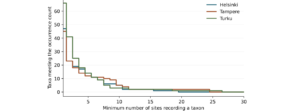
The city pools contained 47 taxa in Helsinki, 45 in Tampere and 66 in Turku. Of these, 24, 22 and 25, respectively, appeared at only one sampled site in their city. Such records create a strict limit to duplication within this inventory: no choice of additional sites can supply a second occurrence of those taxa. Their frequency is an inventory property, not an estimate of rarity across the city. Median individual site richness was five taxa in Helsinki, 5.5 in Tampere and seven in Turku. The occurrence profiles in Figure 1 distinguish taxa confined to one sampled place from those with several counterparts.
The maximum balanced coverage was 33 taxa in Helsinki, 32 in Tampere and 45 in Turku, representing 70.2%, 71.1% and 68.2% of the respective observed pools. For comparison, the median coverage across all admissible balanced selections was 21, 20 and 29 taxa. Those medians describe the design space and do not represent observed practitioner choices. The cumulative distributions in Figure 2 show the complete range of balanced choices.
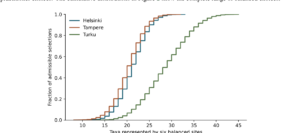
Table 3 shows how the three selection rules occupied that space.
| City | Selection rule | \(C\) | \(W\) | \(R\) | \(U\) | \(\overline{C}_{-1}\) |
|---|---|---|---|---|---|---|
| Helsinki | Local richness | 33 | 28 | 10 | 5 | 29.17 |
| Helsinki | Maximum coverage | 33 | 28 | 8 | 5 | 28.83 |
| Helsinki | Maximum remainder | 33 | 28 | 8 | 5 | 28.83 |
| Tampere | Local richness | 28 | 24 | 13 | 4 | 25.50 |
| Tampere | Maximum coverage | 32 | 26 | 11 | 6 | 28.50 |
| Tampere | Maximum remainder | 32 | 26 | 11 | 6 | 28.50 |
| Turku | Local richness | 44 | 38 | 19 | 6 | 39.83 |
| Turku | Maximum coverage | 45 | 36 | 14 | 9 | 39.83 |
| Turku | Maximum remainder | 44 | 38 | 19 | 6 | 39.83 |
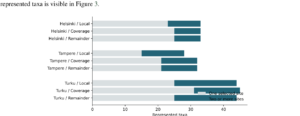
Local richness was neither consistently inferior nor consistently sufficient. In Helsinki it reached the same initial and minimum representation as the two collective rules, with a different pattern of repeated taxa. In Tampere it missed four initially representable taxa and left two fewer after the worst deletion. Its higher value of \(R\) did not compensate for its lower total representation. In Turku local richness happened to identify the same displayed selection as the maximum-remainder rule. Thus neither ranking sites locally nor maximizing duplication has a universal interpretation independent of the observed assemblages. The division between singly and repeatedly represented taxa is visible in Figure 3.
3.2. A trade-off in one city, compatible objectives in two
In Helsinki and Tampere a selection could attain both the maximum value of \(C\) and the maximum value of \(W\). Their nondominated objective sets therefore contained a single pair, \((33,28)\) and \((32,26)\), respectively. Turku had two nondominated pairs: \((45,36)\) and \((44,38)\). Sacrificing one initially represented taxon, 2.2% of maximum coverage, increased the minimum remainder by two taxa, or 5.6% relative to 36. The loss in the worst deletion fell from nine taxa to six.
The position of Turku’s boundary demonstrates an actual incompatibility within the stated constraints, whereas the other two boundaries show that a presumed universal trade-off would be incorrect. Complete enumeration also exposes the consequences of arbitrary tie handling. Four Helsinki selections reached maximum coverage, but their minimum remainders ranged from 27 to 28. Six Turku selections reached maximum coverage, with minimum remainders from 34 to 36. The presented coverage rule uses the strongest of these outcomes, ensuring that the comparison does not exaggerate the benefit of prioritizing \(W\).
Three balanced selections per city in Helsinki and Tampere jointly achieved the primary and secondary objectives of the maximum-remainder rule. Four sites were present in all three such solutions in each city. Turku had one solution after the secondary coverage objective was applied. These are conditional statements about the specified inventory and constraints; they are not estimates of ecological irreplaceability under other objectives.
3.3. The single replacement that changes the Turku result
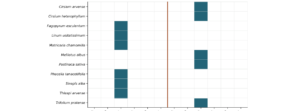
The displayed Turku selections share five sites. Maximum coverage includes suburban traffic island TIc-1, whereas maximum remainder substitutes TIc-5. Within these selections, six taxa occur only in the coverage solution and five only in the remainder solution. The net change of one taxon therefore conceals an exchange involving 11 taxa. This distinction matters because taxonomic totals alone would make the exchange appear smaller than its compositional consequences. The eleven exchanged taxa and their actual occurrences are shown in Figure 4.
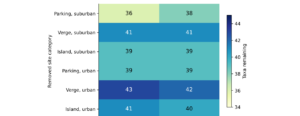
The replacement also changes the contribution of a site that remains selected. At suburban parking site TPc-5, the number of taxa represented nowhere else in the selected set falls from nine to six. The intervention in the decision model occurs at a traffic island, but its largest protective consequence is the reduced dependence on a parking-area site. The deletion outcomes are resolved by site category in Figure 5.
The equal means show why an average deletion result cannot answer a worst-case question. The parking-site deletion outcome improves, two other deletion outcomes deteriorate and three remain unchanged. Protection against the most consequential single deletion is obtained through redistribution of representation, not through a uniform improvement at every site or an increase in the initial total.
3.4. Sensitivity to records and selection constraints
The principal distinction between cities survived two demanding checks. Removing the nine unresolved genus-level entries retained compatible objectives in Helsinki and Tampere and a trade-off in Turku. Using the 92 shared taxa reconstructed from quadrats produced the same Turku pairs as the corresponding site data. Helsinki’s maximum coverage increased from 33 to 34 in the reconstructed matrix, but its maximum minimum remainder stayed at 28. File discrepancies therefore affected an absolute count without generating the main Turku trade-off.
| Data and constraint | Tampere | Turku | ||||
|---|---|---|---|---|---|---|
| Data and constraint | MC | MR | MC | MR | MC | MR |
| Primary, balanced | 33/28 | 33/28 | 32/26 | 32/26 | 45/36 | 44/38 |
| Species-level entries only | 31/26 | 31/26 | 32/26 | 32/26 | 44/35 | 42/37 |
| Mean cover \(\geq1\%\) | 23/19 | 23/19 | 23/18 | 23/18 | 35/27 | 35/27 |
| 92 common taxa, site file | 33/28 | 33/28 | 32/26 | 32/26 | 45/36 | 44/38 |
| 92 common taxa, quadrat file | 34/28 | 34/28 | 32/26 | 32/26 | 45/36 | 44/38 |
| Primary, any six sites | 34/29 | 34/29 | 34/29 | 34/29 | 49/36 | 48/42 |
The 1% filter changed the interpretation more substantially than file reconciliation. The observed pools decreased to 36, 31 and 50 taxa, and all three cities then admitted selections maximizing both objectives. The primary Turku trade-off is consequently sensitive to the treatment of low-cover records. Figure 6 compares the initial representation relinquished under each definition.
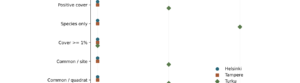
This does not establish that those records are erroneous; it establishes that a management decision cannot be detached from the definition of what counts as represented.
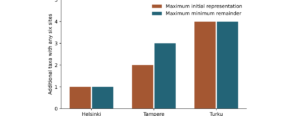
Removing the balance constraint increased attainable representation. Maximum-remainder outcomes rose from 33/28 to 34/29 in Helsinki, from 32/26 to 34/29 in Tampere and from 44/38 to 48/42 in Turku. The unconstrained Turku trade-off remained: initial coverage of 49 taxa had a best minimum remainder of 36, whereas 48 initially represented taxa could retain at least 42. Habitat/location balance therefore imposed a measurable opportunity cost in taxa, while remaining an explicit and potentially defensible design preference. The two consequences of relaxing balance are distinguished in Figure 7.
3.5. What the totals conceal about dependence
The difference between the three cities cannot be explained by the size of the observed flora alone. Turku has the largest pool and the largest attainable balanced coverage, but it also has the only conflict between the two primary objectives. Helsinki and Tampere differ in their city pools and local richness distributions yet share compatibility of the coverage and minimum-remainder maxima. The decisive property is the joint placement of taxon records among eligible sites. Larger pools create more possible records, but do not specify whether those records can be distributed across a balanced selection without concentrating unique contributions.
The occurrence profile provides a necessary check on expectations of duplication. In Helsinki, slightly more than half of the city flora occurs at only one sampled site. Tampere shows a similarly large fraction, whereas the fraction is smaller in Turku. These proportions describe sampled occurrence frequencies, not regional rarity. Nevertheless, they establish a mathematical restriction on the available choices: no rearrangement of the same thirty sites can create another occurrence for a taxon confined to one of them. Increased protection through selection must therefore come partly from deciding which unique contributions to retain and partly from distributing those contributions across sites.
The repeated-representation totals reveal a separate limitation of choosing duplication as a substitute for coverage. Tampere’s local-richness selection repeats more taxa than the two collective selections, but initially represents fewer taxa and retains fewer under its worst deletion. Repetition is concentrated on a smaller overall union. A design that duplicates common plants can thus look secure when judged by repetition alone while omitting additional plants that another admissible selection would contain. The stacked representation figure exposes this distinction without assuming that every repeated taxon supplies the same ecological insurance.
Helsinki supplies the complementary example. Its local-richness selection reaches the same initial and minimum representation as the collective rules and has a slightly higher mean remainder. This is not a contradiction: the minimum depends on the largest site-specific unique contribution, whereas the mean depends on the total number of taxa occurring once within the selection. Equal minimum values can coexist with different totals of single representation. The local-richness selection is therefore not dominated on every quantity displayed in the main table. This result prevents the analysis from becoming a general argument against local inventories; instead, it identifies the conditions under which the collective check changes the decision.
The Turku exchange is taxonomically substantive. The eleven changing entries comprise Cirsium arvense, Cirsium heterophyllum, Fagopyrum esculentum, Linum usitatissimum, Matricaria chamomilla, Melilotus albus, Pastinaca sativa, Phacelia tanacetifolia, Sinapis alba, Thlaspi arvense and Trifolium pratense. Their presence in the exchange does not assign them equivalent conservation status. It demonstrates that the difference between alternatives involves recognizable plants and locations, rather than an abstract subtraction from a total. A practitioner could investigate these records individually before judging whether the arithmetic trade is acceptable.
The incidence image also clarifies why the effect of substitution extends beyond the replaced island. Taxa shared between the incoming island and retained sites cease to depend on only those retained sites. Conversely, taxa associated only with the outgoing island disappear from the selected union, and some previously shared records become unique elsewhere. The reduction in dependence on the suburban parking site follows from these overlaps. It is therefore possible for a change at one habitat type to improve the most consequential deletion outcome at another habitat type without any physical alteration to the latter place.
Removing unresolved genus entries changes the magnitude of the Turku exchange: the remainder-first choice relinquishes two initially represented species-level entries rather than one taxonomic unit. The minimum still improves by two. This comparison shows that the genus-level entries influence the numerical price of the choice without being solely responsible for the existence of the conflict. In contrast, requiring at least one percent mean cover eliminates the conflict under the balance constraint. Taxonomic resolution and sparse-cover treatment therefore affect different aspects of the decision and should not be collapsed into a single assertion that the results are insensitive.
The balance comparison is similarly asymmetric. Helsinki gains one taxon in each attainable maximum after the category constraint is removed. Tampere gains two in maximum coverage and three in maximum minimum remainder. Turku gains four in each of those separate maxima, although its coverage-first and remainder-first choices remain distinct. These are differences between separately optimized feasible sets, not improvements guaranteed by simply adding a site to the balanced selection. The number of selected places remains six throughout. The additional coverage is obtained by permitting different combinations of habitat and location categories, revealing the specific floristic cost of maintaining the imposed balance.
4. Discussion
4.1. From interchangeable surfaces to differentiated obligations
The main implication for landscape architecture concerns the unit at which a design decision is judged. A schedule that lists separate patches, areas and maintenance tasks can encourage a site-by-site account of value. The results show why that account should be accompanied by a collective composition ledger. In Tampere, even a favourable implementation of local-richness ranking left avoidable gaps. In Helsinki, local ranking performed equally well on the two principal objectives. These different outcomes argue for checking complementarity rather than assuming either that rankings always fail or that a richer patch always compensates for a poorer one.
The Turku replacement gives this argument a concrete spatial form. Choosing one suburban island changes the dependency attached to a suburban parking-area patch elsewhere in the selection. A retained site can therefore acquire a different responsibility when another site is substituted. This is directly relevant to briefs that identify places for continued ecological attention, construction protection or additional survey. The appropriate question is not only what grows at a site, but which elements of the retained assemblage would have no counterpart if that site disappeared.
Such a ledger should inform a negotiated design judgement. It does not turn taxa into interchangeable accounting units for compensation. The six-for-five taxon exchange behind Turku’s net difference of one illustrates the problem. A decision favouring minimum representation might be unacceptable if a taxon excluded by that decision were legally protected, locally valued or critical to another organism. Conversely, high inventory coverage might include taxa that should not receive conservation priority. Native status, conservation status, invasive behaviour, cultural value and species-specific habitat requirements were not encoded in the optimization. Applying the method operationally would require these values to be specified before selecting places.
The analysis complements biodiversity-sensitive design by making one decision auditable. Case-based applications of biodiversity-sensitive urban design emphasize translating ecological requirements into concrete urban development choices [22]. Here, the translation remains deliberately limited to floristic representation. A planner can inspect the eligible places, the balance constraint, the taxa exchanged and every deletion outcome. The method offers no reason to replace field judgement, public participation or the social interpretation of spontaneous landscapes with a single maximum score.
4.2. Why a minimum is useful, and why it is insufficient
Reporting \(W\) alongside \(C\) distinguishes broad initial representation from dependence on a highly consequential site. The distinction is most useful where future loss cannot be assigned a credible probability. A worst-case stress test is transparent about the event it protects against: complete removal of one selected site’s contribution. It does not require a fabricated likelihood of road works, redevelopment or management failure. The identical mean remainders in Turku demonstrate that this information is not recoverable from an average alone.
However, maximizing \(W\) is a choice about which adverse outcome matters. It need not maximize the mean remainder, duplicated taxa, total cover or any demographic endpoint. The Helsinki solutions show that designs with equal \(C\) and \(W\) can still differ in repeated representation and mean deletion outcome. A complete decision process should therefore expose alternative optima and avoid presenting the lexicographically selected example as a unique ecological prescription. Site identifiers support exact checking; they contain no normative priority.
The deletion assumption also differs from common landscape operations. Mowing may remove flowers temporarily without eliminating persistent plants or seed banks. Soil disturbance may create recruitment opportunities while destroying existing vegetation. Construction may affect several adjacent patches, and a single maintenance contract may impose correlated treatment across dispersed sites. None of those processes is represented by deleting one row from a presence matrix. The results describe a structural exposure of the inventory, not measured resilience under a particular disturbance regime. Multiple-site losses, recovery and spatially correlated hazards require additional observations and an explicitly different model.
4.3. Sparse records, temporal change and evidence before action
The cover-threshold result is a substantive limitation. A taxon at very low mean cover contributes one unit to the primary objective, as does a widespread taxon occupying much of a patch. This convention is appropriate for asking about representation, but not for asking about floral resource supply or population persistence. The disappearance of the Turku trade-off at a 1% threshold shows that rare-in-the-matrix observations influence the choice. Neither keeping every positive entry nor imposing an arbitrary cover threshold can resolve its biological meaning. Verification requires revisiting the relevant records and deciding which ecological endpoint the stewardship programme is intended to support.
The high number of taxa confined to one sampled site further cautions against equating optimized coverage with security. A record restricted to one site cannot be duplicated by rearranging the same inventory. It may require a targeted survey to locate other occurrences, a site-specific protection measure, or a separately evaluated establishment intervention. The present calculations cannot determine which response is appropriate. In particular, failure to detect a taxon is not equivalent to demonstrating its absence. Summer quadrats do not establish year-round occurrence, detection probability or viability.
Sites were not selected as a random sample of all possible green spaces, and no claim is made that the three cities are independent replicates of a general urban process. Two sites have fewer quadrats. The threshold analysis and file reconciliation do not repair this difference or substitute for repeated seasonal sampling. A new field inventory would be necessary before applying the displayed site selections today.
Finally, floristic complementarity should not be read as demonstrated connectivity. The analysis does not measure movement, dispersal or recruitment between patches. A review of transportation verges found substantial uncertainty about their corridor function for vascular plants [23]. Although spatial arrangement could materially change the value of a selection, the current computation contains no distance-based dispersal assumption. It therefore supports the language of a selected set of places, not a proven functioning corridor network.
4.4. A bounded contribution to landscape research
The empirical contribution comprises compatibility of the two objectives in two cities; a one-taxon/two-taxon trade-off in the third; a hidden compositional exchange behind that small net difference; and the disappearance of the trade-off after a specified cover filter. These findings were calculated from the vegetation measurements and answer a different question from environmental associations. They extend the practical questions that can be asked of an existing inventory without claiming a new optimization theory or new field observations.
The contribution to landscape scholarship rests on a specific relationship between places: changing one selected island redistributes dependence at a retained parking area. Spontaneous vegetation, stewardship and habitat patches are established subjects of research. Here, their practical connection is expressed through exact plant occurrences and removal outcomes. The comparison identifies which collective consequences a local inventory cannot establish alone. It supports a composition-sensitive assessment of existing places while leaving questions of establishment, ecological interaction and management effectiveness to appropriately designed field investigations.
Evidence from urban remnants reinforces the need to retain composition in small-space assessments, while work on urban refugia places those observations within a wider conservation context [24, 25]. These comparisons support examining neglected spaces, but do not transfer their ecological conclusions directly to the Finnish sites. The surveyed quadrats cover only part of each place, and their insect-pollinated flora represents a restricted component of urban biodiversity. A taxon absent from this inventory may occur in unsurveyed vegetation nearby. The denominator used for each city therefore remains the sampled flora, with no extrapolation to a complete municipal species list.
Management evidence also separates increased plant richness from benefits to other organisms. Reduced mowing can alter plant composition, and mosaic mowing can change the opportunities available to pollinators [26, 27]. Studies of traffic intensity and targeted verge enhancement further demonstrate the relevance of the surrounding road environment and the particular animal group assessed [28, 29]. These findings justify checking vegetation and management together before action. They do not allow the selected plant union to be converted into a predicted insect response. Such a conversion would require seasonal resources, pollinator observations and appropriate comparisons between treated and untreated places.
Urban biodiversity assessments likewise distinguish space, vegetation structure and organism-specific responses. Evidence on intraurban spatial variation and pollination shows why an apparently favourable urban setting need not benefit every group equally [30, 31]. The Finnish selection therefore represents one explicit floristic objective among several possible design objectives. Research on mowing costs and benefits adds another dimension requiring direct financial and operational information [32]. Because those measurements are absent here, neither the balanced choice nor its unrestricted alternative can be called more economical. The taxon differences quantify a compositional consequence, leaving the resource requirements of implementation unresolved.
The management of spontaneous flora also needs to distinguish composition from normative value. Work on local management and surrounding landscapes, and on biodiversity within urban development, supports making those choices explicit [33, 34]. Evidence concerning non-native verge plants further complicates any assumption that all floral occurrences carry identical implications [35]. The present unweighted count does not resolve that issue. Before a planting brief is adopted, the exchanged taxa should be checked for local conservation status, origin, establishment behaviour and compatibility with the intended maintenance regime. Those checks could change the preferred selection while leaving the calculation itself valid.
4.5. From a numerical choice to a defensible planting brief
A landscape brief can use these findings most productively by stating what must remain represented before specifying where planting or maintenance should occur. A list of attractive places leaves the relationship among their floras implicit. A composition requirement instead makes omissions visible and allows alternative locations to be compared against the same obligation. Applications of vegetation interventions show that habitat quality can respond to structural changes, but the relevant response varies among organisms [36]. The Finnish calculation precedes that intervention stage. It identifies which plant contributions are carried by a selection; it cannot determine which physical treatment would maintain those contributions.
The same distinction applies to the practical treatment of roadsides. Evidence on roadside management and pollinator conservation makes these narrow spaces important subjects of ecological design, but floral occurrence is only one component of their habitat value [35, 37]. Exposure to traffic, cutting dates, nesting opportunities and seasonal resource continuity may all alter their function. A verge selected for its complementary flora could require a different management response from an island carrying overlapping plants. The presence matrix cannot adjudicate those responses because it contains no repeated observations following changes in management. The appropriate specification would therefore connect retained taxa to verified site conditions, rather than translate a selected identifier directly into a universal mowing prescription.
There is also a distinction between distributing representation and distributing responsibility. Several taxa unique to one selected parking area can create a concentrated management obligation, even if the group of six places looks balanced by habitat type. The Turku substitution reduces that concentration without increasing the initial total. This provides a reason to examine maintenance contracts collectively where they affect ecologically complementary places. It does not demonstrate that coordination will reduce costs or prevent losses, because no contractual, financial or implementation observations enter the analysis. The practical contribution is to identify what coordination would need to protect and which decisions would require further justification.
Social acceptance remains a separate design question. Small urban green spaces support multiple uses and experiences, so a floristic selection cannot settle questions of access, visibility, safety or everyday care [38]. Allowing vegetation to become taller or more heterogeneous may affect those experiences while also changing ecological conditions. Urban meadow research and studies of lawn mowing illustrate why vegetation composition and management form should be considered together [39, 40]. Here, the numerical balance constraint ensures attention to contrasting settings but does not measure whether residents consider that distribution fair or desirable. Those judgements require engagement with the people using and maintaining the places.
An important ethical restriction follows from the use of an unweighted taxon count. The presence of another site recording a plant does not make the first site expendable. Plants can occupy places with distinct soils, histories and ecological interactions, and records at two locations do not establish interchangeable populations. Arguments for recognizing the wider contribution of cities to regional biodiversity support looking beyond simple urban versus nonurban categories [41]. They also caution against reducing urban ecological responsibility to a single aggregate number. The present counts identify substitutions within an inventory; they do not authorize offsets, prove equivalent habitat quality or establish that an apparent replacement will persist.
The focus on one complete removal should also be understood as a choice of question. If several places are exposed to one redevelopment project, protection against a single deletion may provide little assurance about the combined loss. If management temporarily suppresses flowering while plants survive below ground, complete deletion may overstate the immediate disappearance of established populations. Different disturbance processes can therefore make the same arithmetic either insufficiently demanding or excessively severe. Research on fragmentation and small habitat patches emphasizes that outcomes depend on the scale and organization of loss [42, 43]. Extending the calculation to several removals would be straightforward mathematically, but interpreting those removals would still require observations about actual urban pressures.
Repeated surveys would improve the biological interpretation more than adding complexity to the optimizer. Seasonal visits could distinguish persistent occurrences from plants visible only briefly, and recording flowering duration would connect representation more directly to resource continuity. Management histories could indicate whether different sites experience correlated disturbance. Demographic observations could establish whether apparently duplicated records correspond to self-maintaining populations. Research examining plant population success across urban environments identifies these population processes as a distinct conservation concern [44]. None can be reconstructed reliably from a single summer cover matrix, so they remain requirements for operational decisions rather than quantities estimated indirectly here.
The four presence disagreements between the two vegetation summaries warrant targeted checking because small discrepancies can alter exact maxima. Their influence is geographically uneven: the reconstructed Helsinki union increases, whereas the Turku trade remains. This does not make the disagreements negligible. It means that their consequences can be traced to particular questions rather than treated as a general reason either to accept or reject the observations. A useful checking sequence would return to the relevant quadrat entries and identifications, establish whether the aggregation rules differ, and document any corrected occurrence before recalculating site priorities. Until that checking occurs, the two readings should remain visible as alternatives.
Finally, the best attainable value should not be confused with the best implementable decision. Land ownership, access, maintenance capacity and changes since the field survey could exclude a mathematically favourable place. Some tied selections may then become useful substitutes, while a unique optimum may prove especially difficult to implement. The correct response is to modify the eligibility conditions transparently and calculate the consequences, rather than preserve a preferred numerical answer by overlooking practical restrictions. Urban conservation decisions benefit from explicit ecological priorities, but also require recognition that biodiversity has several legitimate dimensions of value [45]. The method supports that deliberation by exposing consequences; it cannot replace it.
5. Conclusion
Within the Finnish site pools, a balanced six-site selection can maximize both initial taxon representation and the minimum remainder after one site is removed in Helsinki and Tampere. Turku requires a choice: maximum initial coverage represents 45 taxa and retains at least 36 after one deletion; accepting 44 initially represented taxa raises that minimum to 38. The apparent sacrifice of one taxon conceals an exchange of six taxa for five and a redistribution of dependence among the retained sites. The trade-off persists across the common-taxon file reconstructions and remains after excluding genus-level entries, but it is absent when representation requires at least 1% mean cover.
The research question therefore has a conditional answer: the taxonomic price of protecting the worst single-site outcome can be zero or positive, and its existence depends on both assemblage composition and the evidence rule used to count representation. Landscape stewardship can benefit from reporting initial coverage, individual deletion outcomes and the taxa exchanged between alternatives. These calculations identify where choices require explanation and further survey; they do not establish population persistence, authorize habitat loss or determine the appropriate treatment of an individual patch.
Declarations
Author Contributions
All authors contributed equally to this study. All authors read and approved the final version of the manuscript for publication.
Conflict of Interest
The authors declare no conflicts of interest.
Funding Information
This research received no external funding.
Data Availability
The data used in this study are available from the corresponding author upon reasonable request.